Core & pair assembly

Pair Twisting & Cabling Machines

Pair twisting with back-twist options, cantilever single twisting and cradle-type laying-up for data and multi-core cables. Compare pair formation and final cable assembly as separate operations.

Explore the selection guide
Cantilever single twisting machine

Choose the equipment for your operation

Pair twisting, back-twisting, cantilever single twisting and cable laying-up equipment.

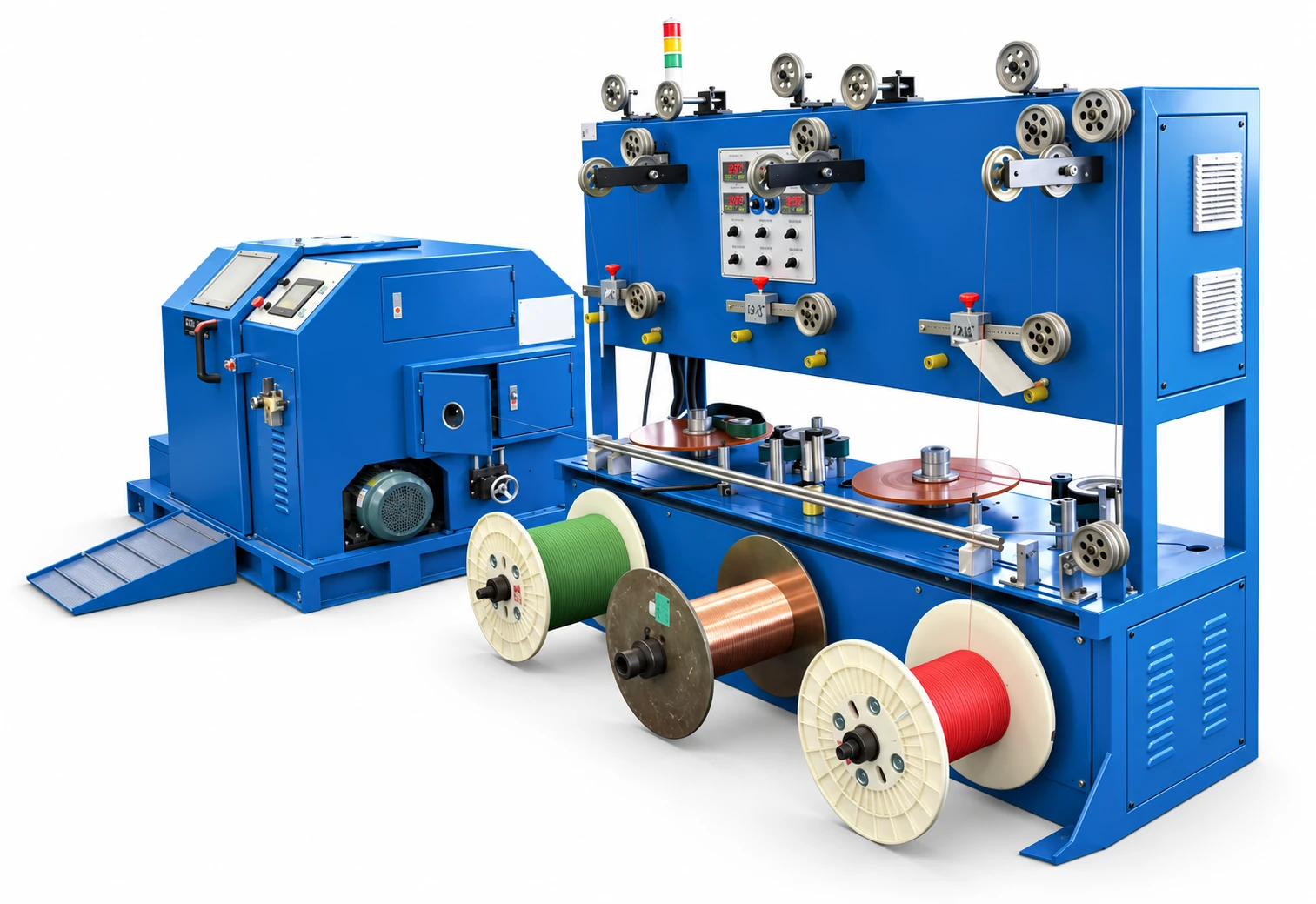
Twisting & Cabling catalogue equipment example
Core & pair assembly

Start with what the machine needs to do.

Material entering the machine
Insulated cores or pairs
Required result
An assembled cable core

Match the working range, material handling and controls to this operation.

Pair twistingLAN and communication cable pairs

Confirm before selectionCore diameter, pair construction, pitch and pay-off conditions.

Back-twisting & pair twistingPair production with a specified back-twist process

Confirm before selectionBack-twist requirements, bobbin format and process arrangement.

Cantilever single twistingData cable and multi-core assembly

Confirm before selectionFinished assembly size, elements, taping needs and take-up reel.

Cradle-type laying-upMulti-core power cable assembly

Confirm before selectionCore count, core diameters, fillers, lay and reel loading.

Which situation matches your project?

Open the operation you need, then review its configuration inputs.

Twisting & Cabling
Twisting & Cabling · catalogue equipment example
Forming an insulated pairTwo insulated cores must become a specified twisted pair.
Review together
Review pair twisting, required pair lay, core dimensions and any specified back-twist arrangement.
Next decision
Provide the pair drawing, input reels and requirements for the later cabling stage.
Assembling pairs and data-cable coresPrepared pairs and other elements must form one cable core.
Review together
Review cantilever single twisting against element count, assembly diameter, fillers, tapes and take-up.
Next decision
Provide the complete core arrangement, including every tape and additional conductor.
Laying up insulated power-cable coresA multi-core construction requires the insulated cores to be assembled.
Review together
Review the laying-up configuration against core count, core dimensions, reel loading, lay and filler handling.
Next decision
Provide the cable drawing and reel details; the cable name alone does not select a machine.
When the scope changes

Pair twisting and final cabling are separate operations. Neither replaces bare-wire conductor bunching. Plug molding, connector fitting and finished assembly testing are outside the cable-manufacturing equipment shown here.

Compare reference configurations

Check the differences that matter to your product. Final selection follows a technical review.

Compact cantilever single twisting

2026 catalogue · p. 29

Review this reference configuration.

Reference modelPY-Φ400/500
PY-Φ400/500
SpecificationPY-Φ400/500
Core specificationAWG32–AWG20
Max. assembly Ø (mm)4.0
Lay (mm)5–60
Take-up Ø (mm)400 / 500
Add a model to your brief

Catalogue application: HDMI, DP, USB and other data-cable core assemblies. This compact configuration is distinct from the larger cantilever and cradle-type machines.

Catalogue figures are reference values. Material, product dimensions and the agreed configuration determine operating output and the final technical specification.

What determines the configuration?

Review the choices behind the equipment package.

Twisting & Cabling
Catalogue equipment example; configuration follows your product.
Separate pair formation from cabling

A LAN cable project usually needs a pair-twisting stage and a later pair-assembly stage. Specify which operation you need and what material enters the machine.

Specify back-twist requirements

Define the required back-twist process and reel arrangement for the cable construction. Do not choose a back-twist configuration from a cable category name alone.

Include tape and filler interfaces

Foil, Mylar, fillers and additional cores affect the assembly path. Identify every element on the cable drawing and confirm which devices are included.

Check the connections around the machine.

Input, equipment and output must work as one connected process.

Incoming materialInsulated cores or pairs
Twisting & Cabling
Twisting & Cabling
Required outputAn assembled cable core
Insulation to pair twisting

Confirm insulated-core dimensions, pay-off reels, tension requirements and the required pair lay.

Pairs or cores to cabling

Check element count, reel compatibility, lay direction, fillers and each tape or shielding interface.

Cabling to sheathing

Agree assembled diameter, take-up package, handling and any separate shielding stage before jacket extrusion.

From this operation to your production line.

See the role of this equipment in each cable project, then open the complete route.

Pair-twisting equipment

LAN & Data Cable

Form insulated pairs before the later LAN cable assembly stage.

Confirm firstSelect pair twisting and final pair assembly separately from the cable drawing.

Cantilever single-twisting equipment

USB & Data Cable

Assemble the specified pairs and additional cores for a data cable.

Confirm firstConfirm assembly size, elements and tape needs. USB connector assembly is a separate scope.

Insulated coresLaying-upAssembled cable core

Power & Building Cable

Lay up insulated cores where the multi-core power-cable construction requires it.

Confirm firstCore size, count, reel loading and filler requirements determine the laying-up configuration. Single-core wire does not need this step.

Insulated coresSpecified assemblyCore ready for sheathing

Power Cord

Assemble insulated cores where the power-cord cable drawing requires a laid-up core.

Confirm firstReview round or flat construction before choosing the route; plug production is not included.

Define your equipment package

Agree the main machine and supporting items together before comparing proposals.

Specify in the equipment list

  • Pair-twisting or cabling machine for the defined operation
  • Pay-off positions and core or pair tension
  • Required taping heads and filler handling
  • Lay control, take-up and reel interfaces

Confirm the related requirements

  • Shield construction and any separate braiding operation
  • Downstream jacket extrusion
  • Connector fitting and finished assembly testing

Compare the proposal, not only the model.

Are you comparing pair formation, core assembly or final laying-up?

Use the same product and scope when comparing suppliers.
DecisionWhat to checkWhat to request
Operation & productKeep pair twisting, back-twisting requirements and final cable assembly separate in the equipment list.A drawing showing incoming cores/pairs and the required assembled core for each machine.
Assembly resultAgree the lay, geometry, tension and appearance checks for representative cores. Cable electrical performance needs its own agreed testing scope.Trial material details, measurement methods and responsibility for finished-cable testing.
Tapes & additional elementsIdentify shields, fillers, drain wires and tapes; an application name does not establish these attachments.An accessory list with each feeding/taping duty and included or separate status.
Handling & changeoverCompare input packages, take-up reels and how the selected construction is loaded and changed.Reel drawings, working-range limits and the product-change procedure to review.

What changes the quotationPair formation or laying-up duty, core count, back-twist requirements, tapes/fillers and reel handling change the package. Mark tooling, supporting units, site works and services as included, optional or buyer-supplied before comparing prices.

Define a useful equipment trial.

Agree the representative product, incoming material, setup, run conditions, measurements and records before the trial. Confirm the acceptance criteria together; a catalogue maximum is not a guaranteed result for every product.

Prepare your selection requirements

Cable structure

Number of cores or pairs, diameters, fillers, tapes and shielding structure.

Process needs

Pair pitch, assembly lay and any back-twist requirements.

Material handling

Reel sizes, loading method, tension needs and finished package.

Line integration

Incoming insulation process, downstream sheathing and available space.

Equipment questions

Can pair twisting and cabling be configured together?

They are separate stages in many cable constructions. A proposal can coordinate both stages around the same finished cable specification.

Do all data cables need the same twisting arrangement?

No. Cable category, pair structure and shielding design affect the process. Share the actual cable drawing rather than selecting equipment by the application name alone.

What should we provide for a cabling proposal?

Send the core or pair count, individual diameters, finished assembly diameter, required lay, reel details and any taping or filling requirements.

Is pair twisting the same as final cable assembly?

No. Pair twisting forms a pair from insulated cores. Cabling assembles pairs or cores into the cable structure. A production proposal should identify each required stage.

What affects the configuration and price?

Core or pair count, finished assembly diameter, lay range, back-twist needs, pay-off arrangement, taping and reel sizes determine the equipment scope. Send the cable drawing with the output requirement.

Your Project Brief

Share the cable you want to make and the scope of your project.

Sample site: prepare and download a project brief locally. No inquiry is sent.